
Boards of Canada and the Divine Comedy of Transatlantic Exchange
For the past 20 years, I’ve felt an uncanny connection to Scotland’s Pentland Hills. A lowland range of sandstone hills southwest of Edinburgh formed some 400 million years ago by ancient volcanic activity, the roughly 20-mile park is home to dramatic faults, pastures, reservoirs, and woodlands. Somewhere among it all is a place I first encountered in the music of Boards of Canada, but here on the other side of the Atlantic, they’ve looked to a landscape they first visited on a fated family trip.
The joint undertaking of brothers Michael and Marcus Eoin Sandison, Boards of Canada (BoC) have spent the past 40 years cultivating one of electronic music’s most elaborate mythologies. Hexagon Sun, their remote artists’ compound and studio in the Pentland Hills has variously been described as an artists’ commune and a repository for bottomless archives of demos and field recordings. After the 2013 release of their fourth studio album Tomorrow’s Harvest, Hexagon Sun was suspected dormant until this spring, when select fans received unmarked VHS tapes in the mail. A cryptic public campaign followed, until BoC announced and eventually released Inferno, their first release in 13 years.
That BoC’s return and the hellish framing of their new album arrive at a time when the boundaries that define Canada’s colonial capture of the landscape are under threat south of its border feels fitting. On their albums, the country for which BoC are named has always provided them a speculative canvas where landscape, public broadcasting, technological intervention, and communal life could crystallize into an alternative vision of modernity. That's part of what’s always made the project so compelling to me, but it also makes it frustrating, because the Canada they imagine often reproduces the country's own exceptionalist mythology, smoothing over colonial violence, extractive capitalism, and the contradictions embedded in the very institutions they romanticize.
Wildlife Analysis
To understand why Canada came to occupy that strange place in the brothers’ imagination, it helps to return to the two years they actually spent here and to the Canada they encountered through the strange mixture of industrial ambition, public media, and cultural life orbiting their childhood.
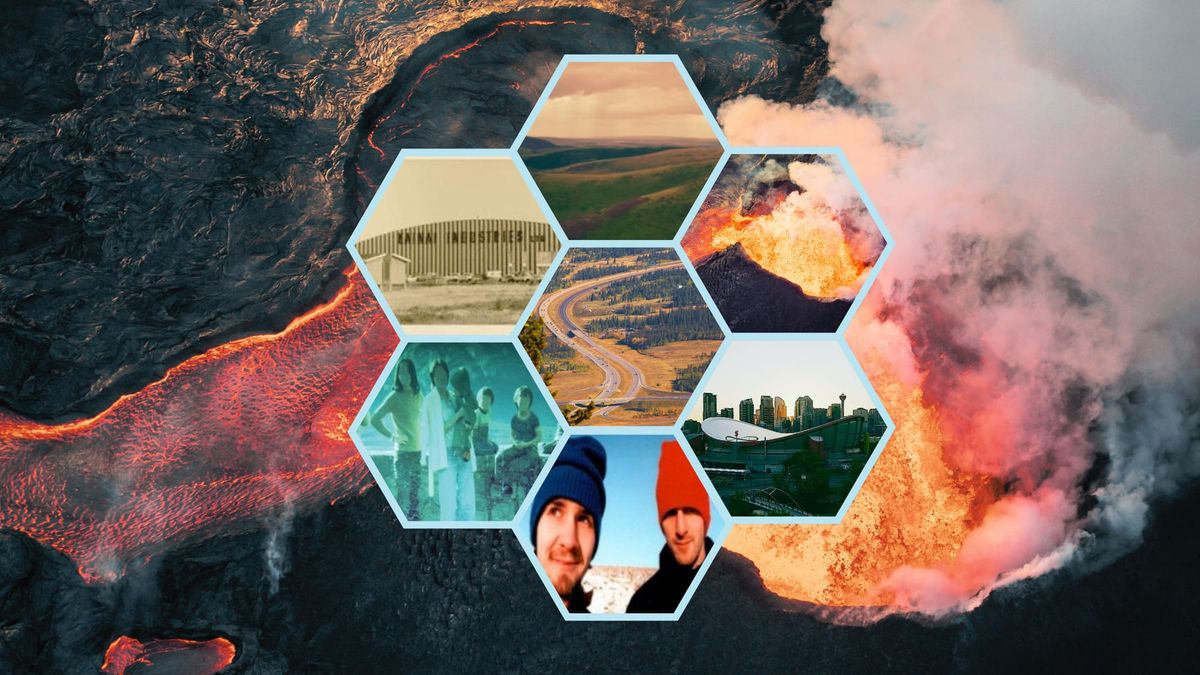
Uprooting from rural Scotland at the end of the ’70s, the Sandison brothers’ two-year stay in Alberta is widely cited as a formative spark in the forging of their collective creative identity. According to the spare interviews BoC have permitted over the years, the Sandison family moved to Calgary in 1979 when Michael and Marcus’s father took on construction work on the Calgary Saddledome, an undertaking immersed in Promethean circumstance — a dual-purpose anchor project initiated by the city during its successful 1979-81 bid to host the 1988 Winter Olympics, the Saddledome proposed an energy-efficient structure featuring a hyperbolic paraboloid roof designed to withstand Calgary winters.
Their father absorbed in heavy industry, the brothers (then seven and eight) are popularly imagined to have spent this time exploring the prairies and the parklands of the province’s Rocky Mountains, the cover of their first globally distributed album Music Has the Right to Children rumoured to feature a Sandison family photo taken at Banff Springs. Given their frequent references to wildlife and nature phenomena, I’ve long let those blurry impressions colour my own understanding of their origins, but their actual accounts of the time suggest the contrary. “My memory of Calgary is a picture of boxy 1970s office blocks dumped in the middle of nowhere against a permanent sunset,” Michael told NME in 2002.
Telephasic Workshop
In spite of their proximity to the natural beauty contained within Canada’s borders, it’s still possible the brothers honed their interests in it at a remove.
“Back then television was a really big deal for us because we were so bored,” Marcus told Pitchfork in a 2005 interview pinned to the release of The Campfire Headphase. “We weren't old enough to go to the cinema and we were in a town where there was absolutely bugger all to do.”
The brothers have confirmed on more than one occasion that they spent a significant portion of this time ingesting a steady diet of educational films and nature documentaries produced by the National Film Board of Canada — media they sampled and paid homage to when their early experiments with crude tape-editing techniques evolved into the melancholic electronic music they eventually produced, naming themselves Boards of Canada in an honorific nod.
Initiated as a wartime propaganda office at the beginning of World War II, by the late 1970s, the NFB was a powerhouse of innovative grassroots documentary. Alongside efforts like the 1974 formation of Studio D, a feminist film production unit home to filmmakers like Bonnie Sherr Klein (mother of Naomi Klein), the public film production and distribution agency became a home to pioneering computer animation and local colour, with cinéma verité docs that explored regional life, labour, and marginalisation from distinct regional perspectives.
Along the way, the Canadian government had inadvertently created the most important incubator for early electroacoustic practice, not in the least part owed to the contributions of Scottish-Canadian animator and director Norman McLaren. Claiming that more than half of his films attempted to capture the spirit of music, he began experimenting with a technique he called “synthetic” or “animated” sound, as presented in the short films Synchromy and Mosaic, wherein sound was produced as a result of drawing or scratching directly into the soundtrack area of film stock. According to a rare in-person interview conducted with The Wire, McLaren’s innovations left a particular impression on the Sandison brothers in their youth, inspiring them to try “sound to light” techniques in their own early adventures in making experimental films with Super-8.
Colin Low, a prolific NFB director who came up through McLaren’s NFB animation unit, had also left an impression. “Pete Standing Alone,” the 14th track on MHTRTC, takes its name from the historical figure of the same name. A member of the Kainai Nation (also known as the Blood Tribe), Pete Standing Alone appears in Low’s 1960 documentary Circle of the Sun, also sampled in the track. Together with Low’s 1982 film Standing Alone and Narcisse Blood’s Round Up (2011), the NFB presented a trilogy depicting Standing Alone’s story in parallel with the communitarian struggles of other members of his community.
Kainai Industries
Collectively answering emailed interview questions, in an archived April 1998 exchange, the brothers wrote to Forcefield that another MHTRTC track, “Kaini Industries,” references “a company that was set up in Canada ( by coincidence in the month Mike was born), to create employment for a settlement of Cree Indians [sic].” While the track’s title is now widely recognized as a misspelling of Kainai Industries, a Blood Tribe-owned housing company that began production on sectional housing in January 1970 and opened a housing plant in July 1971, the brothers’ misframing of the company as a make-work project for “a settlement of Cree Indians” was harmfully dubious.
Firstly, the Kainai are not Cree, but one of three nations constituting the distinct Blackfoot Confederacy that spans the Canada-U.S.A. border. Mislabelling as such perpetuates an erasure of Kainai identity and sovereignty, collapsing distinct and materially unrelated nations into a monolith of generic disposition.
Secondly, Kainai Industries was an autonomous enterprise fully owned by the Kainai. Wittingly or not, suggesting it was a boondoggle administered by the Alberta or Canadian governments plays into a longstanding colonial paternalism that casts Indigenous peoples as dependent wards of the state rather than economic agents in their own right.
According to a 1971 Kainai News story, Kainai Industries was materially unparalleled in its time. Financed by Red Crow Development, a corporation representing approximately 4,500 Kainai people, HaiCo Manufacturing, a division of Wickes Corporation, provided $1 million of operating capital (HaiCo also produced the Aquarius motorhome, a detail that offers BoC fans a portal through which to connect the brothers’ Aquarius EP and the single’s abbreviated inclusion on MHTRTC to the “Dayvan Cowboy”s of The Campfire Headphase and the subsequent Trans Canada Highway EP). “In many places in Canada, plants have been established on reserves,” the story reads, “but this is the first time the Indian people own the fixed assets, and are in effect, hiring the management of the plant.”
Thirdly and perhaps most egregiously, the brothers’ framing of the Canadian government’s relationship to Kainai Industries as a benevolent one couldn’t be further contradicted by reality. In fact, its interventions in Calgary Olympic housing nearly sold the Blood Tribe company’s business off from underneath them. According to a 1987 Windspeaker story digitally archived by Aboriginal Multi-Media Society, Kainai Industries was threatened that year when the Department of Indian Affairs (overseen at the time by future prime minister Jean Chrétien) brokered a plan to sell 200 Olympic housing units from global conglomerate Atco to local reserves.
Given the collaged assembly of BoC’s tracks and their recurring interests in group living experiments and our shared interconnectedness, for a long time, I was admittedly satisfied with assessments like those of British critic Simon Reynolds, which identify the brothers’ articulation of Indigenous subjects as a means of “representing a pre-capitalist way of life at once more grounded and more spiritual in its non-exploitative co-existence with the natural world.” Writing for Pitchfork, Reynolds points out that the brothers’ catalogue “is shot through with psychedelia’s abiding obsessions: nature, childhood, higher (or simply other) states of consciousness, and the allure of a tribal mode of communal living,” but now I’m convinced the exotic lens through which BoC viewed Indigeneity within Canadian borders prevented them from glimpsing a crystallized form of that (indeed un-foreclosed) communal instinct shining in the uniform rough of industrial colonial capitalist modernity.
Corduroy Psychedelia
Born and raised in Southern Ontario, when a friend first tipped me to BoC in high school and I started delving deeper into their deep swirling well of references, the brothers’ titular fixation on Canada always perplexed me. What could two brothers from Scotland possibly find so inspiring in the perhaps more thoroughly colonized Commonwealth nation across the Atlantic? In their music, Canada becomes less a real place than a speculative crucible for a more collectivist future where vast wilderness, postwar social democracy, educational broadcasting, technological experimentation, and communal forms of life converge into an alternate modernity.
Perhaps mercifully, BoC’s touchstones are never limited to Canadiana. Alongside the NFB are fragments of Sesame Street, and British nature documentaries; what connects these sources is less nationality than institutional texture. In his essay “Corduroy Psychedelia: On Boards of Canada, Hauntology and the PBS Unconscious,” Sereptie (blogonym/musician handle of philosopher and educator Craig Laubach) writes evocatively of BoC’s affective apparatus, describing their aesthetic as corduroy psychedelia, a species of hauntology rooted in the strange visual and sonic language of late-20th-century public broadcasting.
For Sereptie, the era’s public communications were defined by what he called “a particular porousness between high modernism and the children’s programming block,” while “low-budget visuals” and “genuinely cinematic” portrayals “exuded an aesthetic mixture of run-and-gun style cinematography and the flat affect of civic realist filmmaking” — supposedly “the exact alchemy of transcendence needed to temporarily flee the suburban spiritual imprisonment felt at the threshold of American deindustrialization.”
Sereptie also suggests corduroy psychedelia may be a distinctly transatlantic phenomenon, pointing to an intercontinental exchange of public infotainment. “PBS regularly imported British programming from the BBC and Channel 4, while Canadian public broadcasting content crossed both borders,” he writes. “Together, North America and the UK produced a shared anglophone public broadcasting unconscious whose institutional register, civic realist and softly uncanny, was remarkably consistent on all three sides of the Atlantic.”
“We saw them in both Canada and Scotland,” Marcus told Pitchfork of his and Michael’s NFB consumption in a 2005 interview. “The films were on television in the UK for years.” BoC mirrored that exchange throughout their catalogue — in addition to NFB material, “Pete Standing Alone” also features samples from On the Tracks of the Wild Otter, a 1982 instalment of the BBC documentary series The World About Us, and the same documentary is sampled elsewhere in MHTRTC’s “An Eagle in Your Mind” and a track from their follow-up to that release, Geogaddi (“The Smallest Weird Number”).
Somewhere Right Now In the Future
At least from a distance, Canada offered the brothers a way to imagine a more collective future without abandoning the technological and media-saturated modernity that fascinated them.
I’ve long been drawn to that vision, but the contradictions in the brothers’ treatment of indigeneity make it harder to accept its underlying premise. The communal life the Sandisons seem to admire was never separate from the colonial institutions and economic systems that shaped the country around it, but I also suspect it’s not coincidental that BoC’s music has never positioned itself as an unclouded zone of idyllic vision.
For much of Boards of Canada’s early catalogue, Canada seemed to present less a cultural monolith than an informal global commonwealth laboratory. On Boc Maxima, “Nova Scotia Robots” invoked the Maritime province whose name literally means “New Scotland,” folding the brothers’ birthplace and adopted mythology into a single transatlanticism while a synthesizer wanders aimlessly through the alien terrain of machine voices. The psychedelic guitars and sampled documentary audio on “Niagara” and its gestures to the river simultaneously dividing and connecting Ontario and New York, meanwhile, take a sinister turn when they ride the arc of a phaser into the nervous, disembodied repetition of a child’s laughter. Music Has the Right to Children is routinely applauded for the nostalgic glow it radiates through its autumnal renderings of youth and institutional memory, but its halcyon melodies and dreamy suspension is routinely haunted by their predilections for decay and distortion, often to unnerving effect.
If we trace that sense of unease as it presents itself across their back catalogue — from the cozy pareidolia of The Campfire Headphase and the passenger seat roadside attractions of Trans Canada Highway to the apocalyptic prophecies of Geogaddi and Tomorrow’s Harvest — over the historical progression of the neoliberal order and increasingly frictionless postmodernism amongst which they’ve lived their entire lives, it becomes harder to read their Canadian mythology as an approving celebration of the country itself.
While 2013’s Tomorrow’s Harvest gestured to oncoming ecological failure, institutional decay, and technological unease, on Inferno and in the landscape within which we receive it, the affect feels hardly anticipatory, but the result of highly pressurized active collapse. Arriving in a world littered with AI-generated unreality, naturalized human-imposed wildfires, and the erosion of the educational and broadcasting infrastructures that once animated the duo’s imagination, the damnation of Inferno is consuming, but not without its glimpses of salvation.
Arena Americanada
With the world set ablaze, the harder it becomes to distinguish Canada from its neoliberal counterparts, and on Inferno, BoC responds with the closest thing they’ve ever offered to criticism of their namesake, smashing Canada into its neighbour in “Arena Americanada.”
Arriving at the time of accelerated spending on military and fossil fuel expansion conveniently prompted by a Trump-imposed trade war, the portmanteau appears to gesture to the squaring off of neighbouring counterparts, but its synthesis also suggests the shared hubris of the nations. Shrugging off decades of hard-campaigned Canadian exceptionalism, the title highlights how Canada’s national self-image of apologetic tolerance and global progressivism often obscures the same composition of deep-seated systemic inequalities, corporate exploitation, and imperial instincts that belie the United States and other outposts of neoliberal capitalism. In execution, the brothers infuse the track with the prog schlock of stadium-ready instrumentals, but they gradually temper their bombast to near ambience, so when the clouds part for the beatific wonderment of “You Retreat In Time and Space” after the liminal interruption of “The Process,” redemption still feels within reach.
Twoism
The mythology of Michael and Marcus Sandison’s muse is compromised, in some ways perhaps irretrievably, but like all things worth saving, its contradictions are part of what makes it worth returning to. The Sandisons may have mistaken some of what they encountered in their childhood visit from across the Atlantic, but through their comedy of errors emerged a sublime vision of a place that could be. Canada was never quite heaven, and Inferno makes clear it never could have been, but somewhere between the static and the tape hiss they strung across the ocean, perhaps Boards of Canada lit the way to a better future that could repent for those sins.