
Nothing Changes Everything: John Wright’s Next Chapter
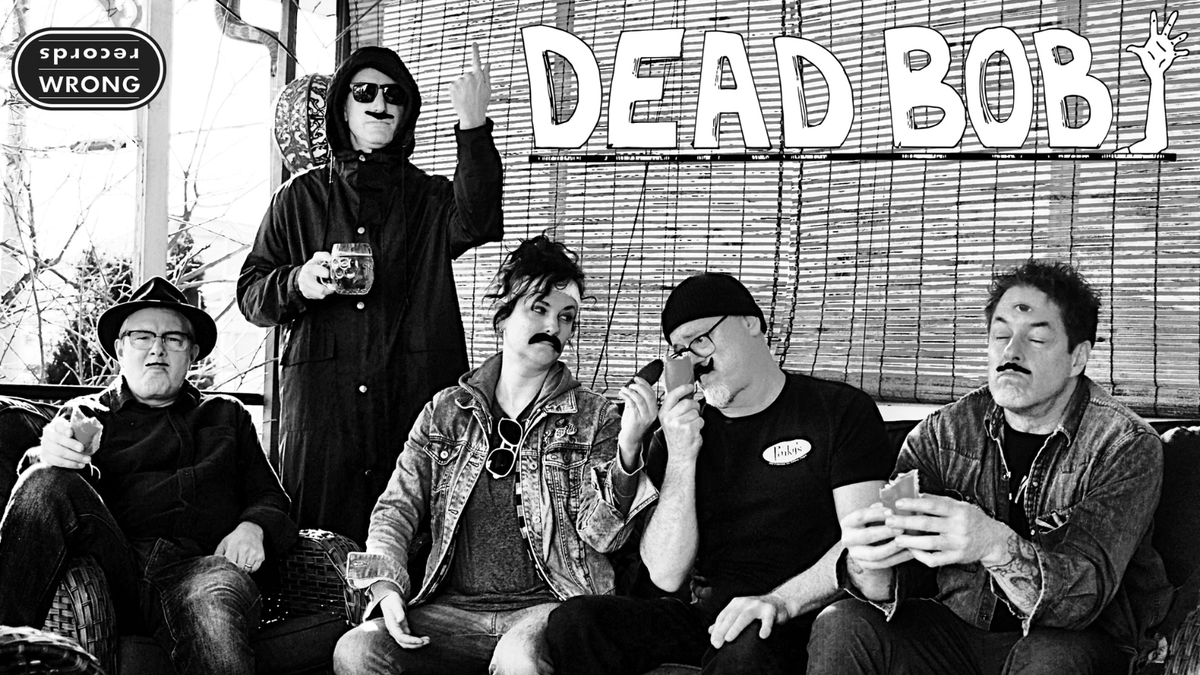
“Being creative has been a driving force for me since I was a child,” John Wright says. Speaking over a video call on a warm spring morning from his home in Victoria, British Columbia, he’s fresh off the heels of a tour in support of his project Dead Bob’s latest album, Nothing Changes Everything. “I think I've been blessed with the ability to do something that I really enjoy for a very long time.” Wright, 64, exemplifies this idea of constant evolution as an artist. With a career spanning five decades, a discography that spans dozens of releases and multiple bands including post-hardcore pioneers Nomeansno, and branches out into multiple disciplines, Wright is one of Canada’s most prolific and influential musicians. Now in a new phase of his musical journey, which sees him taking the role of bandleader in solo project turned quintet, Dead Bob, he continues to create and experiment.
The eight song release is a whirlwind affair, carried by a propulsive, energetic flair. Each song showcases the accumulation of Wright's experiences as a songwriter and arranger, calling back to the eclectic mix of projects he has participated in. “It's a non sequitur,” Wright explains the philosophy behind the album's title, which also serves as an encapsulation of the artistic impulse that pervades the release. “A paradox. It's two things that are opposed to each other, but somehow mean something at the same time. That the world, as we see it, we create it.”
Songs like “Punkrock-A-Rama” are anthemic romps that evoke the classic punk sound, while “The Present” is an abstract, largely instrumental post-rock reminiscent dirge that evokes a sense of sombre mystery. “I love the Ramones, which is the same thing for 40 minutes, every record, and I love it,” Wright explains. “There is that, and that's fine. But I think this album is more showing me personally.” The lyrics sung throughout the album are existential and surreal explorations of emotion and psychology, full of abstraction and a distinct sense of humour that Nomeansno was famous for. “I really learned over the years with my brother that the music has to cut a little deeper,” Wright says regarding the influence of his brother on his approach to lyrics. “and just both be fun and playful, but also not always pretty. And, like I say, ‘where's the emotional heart of what you're doing?’” The album is a culmination of lessons learned and experience gained over the course of his life; the next step in a story that began years ago.
A veteran figure in Canadian punk, Wright has been performing since his teen years when he formed Nomeansno with his older brother Rob in 1979, inspired by the burgeoning punk and hardcore scenes of the late ‘70s and the surrealistic artistry of the Residents. From a young age, Wright’s creative spirit was active, with music as a primary point of interest. What began as drumming on pots and pans as a little kid turned into a dedication to music that was developed in high school. It was there that he picked up piano and gained a keen interest in compositional arrangement and jazz. This was a pivotal and influential time for Wright as the ‘70s saw numerous genres experiencing periods of maturity, growth, renewal, and mainstream attention such as jazz-fusion, progressive rock, country, reggae, disco, hard rock, and heavy metal to name but a few.
Rob, who is older by eight years, had much more exposure to the trends and movements happening in the underground music and art scenes happening at the time. The enigmatic sounds of avant-Garde art collective The Residents were a particular point of interest as they would provide a lasting influence on the brothers’ later work.
“He was sort of abandoning all the blues rock, and jazz, and all the shit he'd listened to all in the 70s,” Wright explains. “And he introduced me, really, to all that new music coming out.”
When Rob started introducing him to the contemporary early punk scene via the records he brought home and took him to a DOA show, the experience ignited young John’s love for punk and laid the foundation for his career as a musician. “I never heard a drummer play that fast, and the music was so fucking good, and it was chaos, really,” Wright says effusively. “Well, I was hooked.”
Older siblings and cousins often serve as important conduits of cultural transmission, exposing younger members of their families to trends that might otherwise remain unfamiliar to them. For the brothers, this would go both ways as John would also inspire his older brother to take a more active role in the music scene.
“He was an introvert in a lot of ways,” Wright explains. “It was a step for him to come out and play live music. So I kind of dragged him out of the basement in a way, because I'm like, ‘yeah, let's go play.’”
Rob’s influence would take this a step beyond that, as The brothers, at the urging of Wright, would spend the next 38 years performing together in Nomeansno until Rob’s retirement in 2016. During this multi-decade period, they would also form or participate in a myriad of other bands and side projects, each exploring a different aspect of their creative interests such as The Hanson Brothers, a satirical hockey-themed group that explored a more classic pop-punk tinged sound or Show Business Giants, the project of their friend and frequent collaborator Tom Holliston. These projects each showcase the eclectic songcraft of the brothers while also carrying their signature freneticism.
His approach to playing drums stood out among his peers as, hearkening back to his jazz influences, he was one of the few drummers in the punk and post-punk sphere who employ the asymmetric traditional grip alongside other idiosyncratic players like Stewart Copeland and David Narcizo of Throwing Muses fame. “Through school, I was in the jazz band,” Wright explains, “and I was never a great jazz drummer by any stretch, but that's how I got started playing the drum kit and whatnot. So when I got out when I was in high school and getting into punk rock, that's the way I played.”
Nomeansno experimented with and incorporated a wide range of elements into their sound. Almost nothing was off the table sonically, with everything from musique concrète and sound collage to funk, ska, dub, and spoken word. All of this was filtered through the brothers’ appreciation for loud and energetic production, with Rob’s melodic growling bass lines and John’s highly dynamic, propulsive playing as an anchor. “Getting into punk rock was like the rules were out the window. Just be yourself,” Wright says with a smile. “I wasn't totally awesome with all the technical stuff, but through jazz, I just approached the drum set as a musical instrument, not so much as a beatbox. I got better, obviously, at playing technically.”
With the end of Nomeansno in 2016 and Rob’s retirement from live music, John found himself separated from his brother in the realm of music for the first time in decades. “[Rob] was really having trouble with his hip”, Wright tells me about that period. “He was kind of like, ‘Well, if I can't load my own fucking gear, I don't want to go do this.” Initially, Wright spent much of his energy on brewing his own beer and running a bar until the COVID pandemic derailed the enterprise. The musical bug asserted itself again in this period after spending time going over old demos, with a particular moment involving the original keyboard demo of the Nomeansno song “Life Like.” “[I thought], this would be great just to do this up as the pop song that it was kind of written to be.” The recreation of “Life Like”, with France-based Canadian singer/songwriter Selena Martin contributing vocals, proved pivotal to the current phase of the younger Wright’s life and marked the beginning of what became Dead Bob.
“I wanted to hear it slightly slower with all the fucking keyboards, all the little frills and dingle dangles,” Wright says. He opted to include Martin on the rerecording as a means of adding tonal depth. “I wanted there to be a kind of unisex vocal tone. Not just Robbie, not just three guys, blasting them out.” This decision proved fortuitous for Wright. “There was no intention of it being anything more than just for myself, but then when I was getting a bunch of stuff together and I thought, well, I could release this as a project, you know, just to get it out there, these songs were written, might as well do something with them. I might as well put them out there. And that's kind of how Dead Bob came around.”
Before Dead Bob, Wright had previous front man experience with the Hanson Brothers drumming duties being handled by a series of long-time friends and collaborators from 1991 to 2016. But those contexts were different, as he was still within the collaborative period with his brother. With Dead Bob, he was the primary driving force. The resulting album, Life Like, would contain all the elements of what the project would grow into but with an austere, somewhat darker and synth heavy approach to the production and arrangements.
A central element to the story of Wright and his creative endeavours is a strong sense of community, both with other musicians, the listeners, and the audience. From his earliest days in the Victoria punk scene to his most recent tour, Wright has built relationships with people from all over the world. “We’re most comfortable just being ourselves,” Wright explains. “And when we dealt with people, we always just gravitated to people that we could be friends with.” The breakdown between band and audience that has long been central to the punk rock subculture is embodied in Wright’s attitude. “We're not stars, no matter where we go, we're not stars. But we know that it’s the connections that you take with you, personally.” This eschewing of the typical “rock star” trappings and expectations, puts more of a focus on both the music and the live performance where the audience is placed into the role of participant as much as observer.
This sense of community filters into the music, as much of his discography is made up of group affairs in some fashion. In-addition to the bands he performed in alongside his brother, Wright has played as a member or guest in other bands and projects as a guest drummer for DOA and Infamous Scientists, and a musical director of the animatronic robot band Compressorhead. “I've always been a collaborative type artist,” Wright explains, “so when other people are excited, that excites me too.” It is no surprise that Dead Bob would grow from a solo project with guest musicians to become a full band, both live and on record with Nothing Changes Everything seeing the project solidify into a five-piece lineup with outside guests appearing on several songs. This stands in contrast to more recent trends, where the solo musician doing it all themselves has become much more common.
The group format allows for a different range of creativity, as new voices and timbres are added to the mix that Wright, now primary songwriter position, can arrange for. “Everyone in the band basically has been or is a lead,” Wright says about the free-form configuration. “So they can all step up and take the attention away from me and there's all these dynamics to work with. The first album was just kind of me.” Each member of the band brings their own tastes, experience, and sensibilities that come across in the songs and live performances. The rousing nature of many of the songs is a testament to this approach, with the tagline “everyone sings” acting as a sort of mission statement for not just this release but most of Wright’s discography and artistic sensibilities. “I'd like to think that Dead Bob has wide parameters of what we can do,” Wright explains. “And I think this album was me really thinking, ‘Okay, this is where I'm at musically’ — the dynamics of what's going on musically, from song to song.” Live, the band members frequently exchange instruments to attack different songs. It is a well-orchestrated yet free-form mode of communal expression that embodies the spirit of the music.
Dead Bob continues to evolve as the members grow together as a unit with Wright.
“It's still sort of me finishing up songs from the past, creating something out of stuff that I've done myself,” Wright says. “This is where we can start the third album, I think, where we could really showcase Dead Bob as the five of us.”
In his 60s, Wright is as prolific as ever, constantly writing and arranging new music. With an ever-growing list of musicians in the heavy music space performing and making new music and daring well into their advanced years, he is in good company. Despite challenges that come with touring in the current age of geopolitical turmoil, Wright soldiers on and remains excited about the world of music and the new bands that are keeping the spirit of experimentation and creative abandon alive. “Any time young people or anybody sits down and starts to express himself musically,” Wright says with a smile, “it has value, I think.”