Embracing Your Inner Monster with Monstrosa
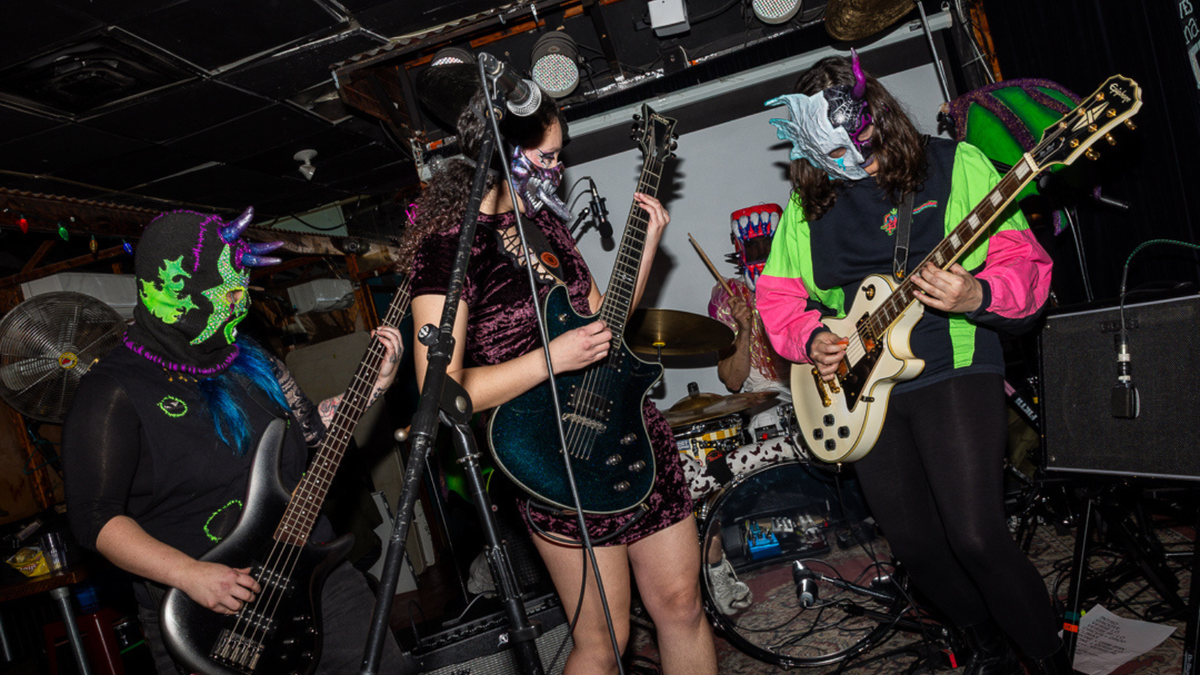
The neon lights that hit the stage are nothing in comparison to Monstrosa’s colourful and imaginative regalia. From a giant, fanged mouth tearing at the drums to a guitarist sporting a Two-Face-style mask, all four members of the alternative metal band sport their own personalized look and alter ego.
As soon as lead singer Lauren Pryce’s sirenic vocals hit our eardrums through her purple-toothed mask with tusks protruding, I know it’s a done deal.
Folks who piled in early to Kensington Market’s Handlebar are already on the floor, while others prep to take videos of what’s sure to be a one-of-a-kind performance, or excitedly squirm in their seats ready to enjoy the show. Monstrosa is a sight to see and made to be experienced live.
The fans in the crowd seated by the bar or swaying in the mini-mosh pit, come alive at the hypnotic sounds of their music. One person shouts out “I love you” after a track, another records videos from their phone, and a couple sitting next to me mouth every lyric of their set.
More than just a metal band with elaborate costumes, Monstrosa is a project built on friendship, mutual care, and radical self-expression.
After Pryce, the band’s lead and lyricist, was diagnosed with borderline personality disorder, she says she turned to music because she needed a way to cope.
Writing has always been a means of survival for her, so putting pen to paper was a natural next step. But after longtime friends and Monstrosa alumni Emma Ember and Shannon Fischer listened to the song, they encouraged Pryce to make the jump. She’d always wanted to be in a band, and finally, in 2019, the three launched Monstrosa.
Led by Pryce’s ethereal vocals, reminiscent of Evanescence’s Amy Lee and Lacuna Coil’s Cristina Scabbia, Monstrosa’s brand of alternative metal is both familiar and all their own. Sonically, Monstrosa has the musicality of metal greats mixed with an emo spirit, but their vulnerable, honest, and sometimes funny lyrics are what keep their fans going. They tackle everything from learning to take up space in a sexist world to the bleak reality of being young in a late-capitalistic world, sometimes with a tongue-in-cheek approach, like in “778” or with complete sincerity, like in “Platonic”.
The name isn’t for show. When it comes to Monstrosa, every member is their own monster.
Brainstormed with the group, each band member crafts their own alter ego, inspired by their own personality and struggles, which are then channelled into a mask made by the band’s bassist, Brittany Tate.
Through their persona BR☆T, Tate embraces the rebel they wish they were while donning a decked-out balaclava with rhinestoned eyes, multiple horns, and a multi-fanged circular mouth.
The softspoken drummer Coco rocks a horned jaw open wide, dripping blue goo from its teeth. No alter ego is the same, and all are personalized and crafted to withstand the intensity of live shows.
It doesn’t just stop at the alter egos, though; their live shows are true performances, including rehearsed scenes, guest drag artists invited onstage for select songs, and a dynamic lineup of musicians.
Monstrosa has grown in numbers since its inception, going from three to now eight members, and counting.
Jess Roveda was a later addition to Monstrosa. After subbing in for a couple of shows, she was invited to join full-time as a band member in mid-2024.
“When I played music with them for the first time, it all felt very good, which doesn't always happen,” Roveda says. “It either feels like it all comes together or it doesn't. And I felt that way from the start.”
The band works more like a collective, where a good couple of hangs and performances can lead to being part of the Monstrosa-verse. They are always expanding but without the expectations of normative bands.
With varying schedules, access needs, and energy levels, it was key to allow Monstrosa members the flexibility and permission to back out when needed.
“It kind of came out of necessity,” Pryce says. “I don't want the band to be a source of stress in people's lives. I want it to always be accessible to people, regardless of what they're doing.”
“We're also humans too,” Tate adds. “As much as we're monsters, we're humans too and we all have our limits.”
They compare the band’s philosophy to a revolving door. “You know that if you're not at this [show], you're always welcome back at the next one… You're still part of the family.”
And that family also extends to its fans.
Monstrosa’s live shows are built to be a space where, in the words of Pryce, “we can be ourselves, and other people can too.”
“I'm very open about the fact that I'm mentally ill. I'm open about being queer. And so are the other members. And I feel like that's one of the reasons people gravitated towards it because they’re like, ‘Oh, that's a space where I can be myself,” Pryce says. “That’s at least what I hope. Because to me, live music wasn't always a welcoming space. Sometimes I'd go see local bands and it was almost like they wouldn't want anything to do with me.”
Coco likens Monstrosa to an antenna, with a set frequency that attracts all the like-minded weird, queer, mentally ill metal lovers to their shows.
Tate says Monstrosa brings them connection and “a lot of love.”
“I've met so many more people being part of this project than I have my whole life.”
In a scene where metal can still feel exclusionary, Monstrosa has built something stranger, louder, and stronger, built by and for all the monstrous feeling queerdos out there.
Read more
What Does Sampling Mean in An Era of Instant Music Generation?
Singing Heavy Songs