
Zero Latency: On the Possibility of World Soundscapes beyond Spotifycore Sovereignty
“Schizophony is R. Murray Schafer’s term for the audible inferno of the post-war soundscape, the era when industrial communications split sound from its sources, ‘becoming a fearful medium because we cannot see who or what produces the sound: an invisible excitement for the nerves.’”
-Kodwo Eshun, More Brilliant Than the Sun: Adventures In Sonic Fiction
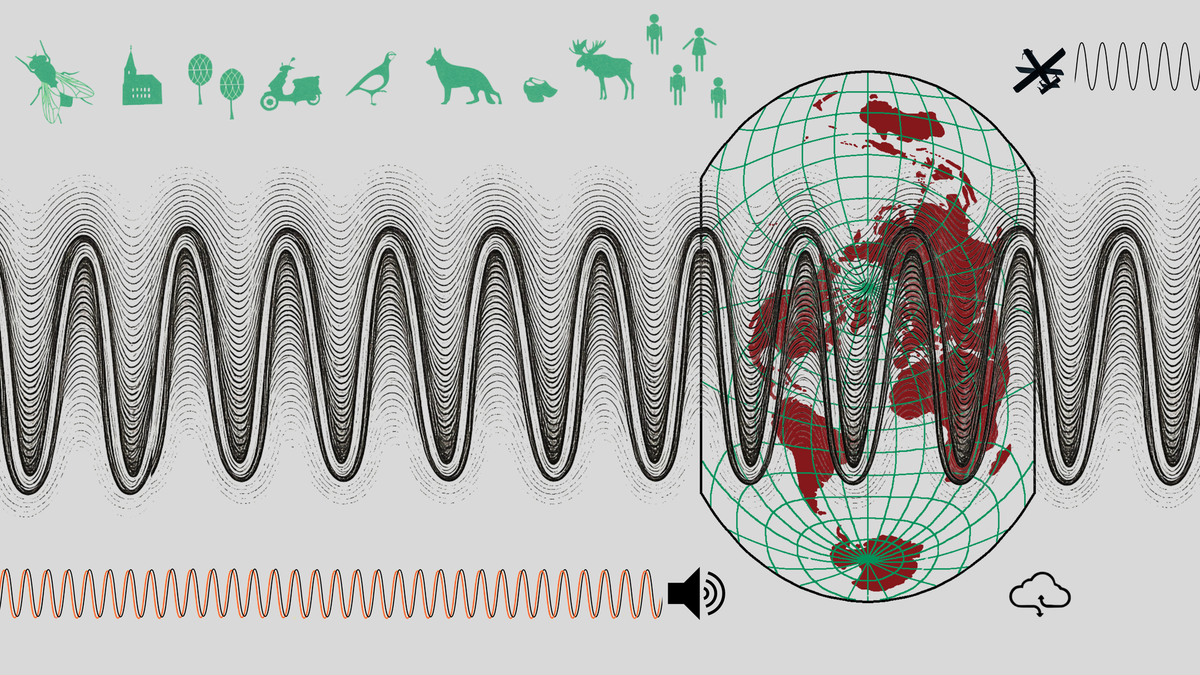
Canadian composer and educator R. Murray Schafer developed the World Soundscape Project during the late 1960s as an attempt to understand sound as an environmental system rather than an isolated artistic object. Through works such as The Vancouver Soundscape and writings including The Soundscape: Our Sonic Environment and the Tuning of the World, Schafer proposed that modern societies produce distinctive acoustic environments composed of and within a signal-to-noise ratio. These auditory environments organize a psycho-spatial social relation that emits a subtle ecological emotion, memory, attention, and collective behaviour. Schafer’s concept of schizophonia—the separation of sound from source through electroacoustic reproduction—identified recording technology as a decisive transformation of modern perception in which detached and disembodied sonic figures refer to an environmental origin. Sound thereafter could circulate independently from its emotive creators as atmospheric commodities. Under the conditions of streaming media and machine learning, schizophonia articulates the dominant cultural logic of platform capitalism. In this way, algorithmic suggestion mobilizes music beyond a situated ritual performance into metadata waveforms circulating through the generative behavioural analytics of recommendation systems trained on archives of recorded culture. Genres collapse into searchable vectors and listening environments are personalized through adaptive playlists and AI-assisted biometric feedback systems that anticipate user mood and attention patterns before conscious decision-making occurs. The auditory scene and search index has become computationally managed in the desired economy of user and programmer relations.
The contemporary streaming soundscape represents a further evolution of Schafer’s schizophonia where digital platforms transform recorded audio into searchable metadata, compressing a song’s essence into a data structure capable of being sorted and recommended according to patterns of attention. The World Soundscape Project’s concern with acoustic environments therefore becomes newly relevant in that the modern soundscape is no longer shaped only by industrial noise or urban expansion, but by computational infrastructures that determine which sounds become audible. Schafer’s distinction between hi-fi and lo-fi soundscapes anticipates a looming crisis of computational listening where the listener has tuned out the physical noise of urban environments with noise-cancellation audio devices tethered to a torrent of recommended human-and-AI music.
What distinguishes the present moment of generative AI derivatives from previous eras of automation and downsizing in the music recording industry is the degree to which computational systems optimize the temporal conditions of listening itself. In the streaming economy, latency optimization and predictive search are infrastructural techniques for governing perceptual delay between user input and playback. Zero latency is at once an engineering achievement as well as an ideological operation designed to eliminate friction from musical consumption. Playback occurs almost instantaneously, producing the sensation that listening environments emerge naturally rather than through commercial orchestration. In the book Mood Machine: The Rise of Spotify and the Costs of the Perfect Playlist journalist Liz Pelly critiques Spotify’s strategy to facilitate less active listening through the continuous modulation of streamed–formerly canned–audio as affective frictionless states of cognition. She describes that founder Daniel Ek’s singular goal was to elevate the cloud-sourcing of music files from piracy into platform economics, ostensibly “freeing” up music’s overall availability to the general public, i.e., the market. “The engineering team even gave themselves a specific metric,” Pelly writes. “Any song should begin within two hundred milliseconds of pressing the button.” The feeling of instantaneous playback via latency optimization restructures listening temporality with unhesitating autoplay algorithms that fill perceptual gaps before silence can emerge. Listeners are transferred from one track to another through seamless transitions, and the predictive auditory scene becomes continuous and atmospheric, untethered from decision-making and active discovery.
At the same time, predictive search reorganizes musical culture around computational legibility where search systems amplify content that behaves predictably. Metadata architectures enforce an invisible hand that guides tracks that are tagged efficiently into recommendation conveyor belts because platforms increasingly reward what Pelly among other critics have termed “Spotifycore.” Even the app’s name itself surfaced as the result of latency and disordered audio-processing, when Ek misheard co-founder Martin Lorentzon’s shouts of potential names from a separate room––later the name became understood to be a portmanteau of the words "spot" and "identify." Spotify's mood-based and playlist-centric structure–in conjunction with noise-cancelling listening technology and Apple’s little white earbuds–incentivizes a compressed, homogenized “aural wallpaper” that prioritizes background utility over artist identity. Pelly’s The Mood Machine focuses on "streambait" and fake artists that exploit the 30-second stream rule; whereas, the 2019 book Spotify Teardown: Inside the Black Box of Streaming Music by Swedish social science researchers Maria Eriksson, Anna Johansson, Rasmus Fleischer, Pelle Snickars and Patrick Vonderau conducted a five day “back-end investigation” with a custom-built interface in which a small fleet of bots were deployed to collect and analyze data from Spotify’s recommendations feature.
The hypothetical framework of the study was to perform an algorithmic audit in order to gather quantifiable statistics on the quality of methods that decides what songs or artists Spotify recommends to listeners of different genders. The initial result of the study yielded no answers, but did show that there was simply too much data for their interface to process: a bold aspect of Spotify’s mystique and selling point. The massive glut of data collected from Spotify’s “black box” seemed impossible to digest and only consumable in small doses. At the core of Spotify’s recommendation feature is the music analysis firm, The Echo Nest, which the streaming platform acquired for €49.7M in 2014. Founded in 2005 at the MIT Media Lab as a dissertation by Tristan Jehan and Brian Whitman (brother of electronic musician, Keith Fullerton Whitman), The Echo Nest operates as a centralizing model of data intelligence that Spotify uses to provide users a seemingly personalized listening experience. Now, under the power of automated suggestion our listening has shifted overtime from an active engagement with music to a passive habit.
Spotify’s “black box” conceals much of its internal logic beneath interfaces organized around personalization and convenience where the reduction of latency begins to function ideologically. Metahaven’s conjectures in the essay “Latent Spacecraft: Brains, GANs, Finnegans” deepen this condition by reframing latency as a defining temporal structure of planetary computation itself in which computational systems can never fully eliminate delay. “Latent spaces” are described by Metahaven to be embedded features, spatial vectors that posit an interstitial zone between material and abstract conceptions of the world that “can be laid out as an architectural map, which in turn makes it possible to physically explore abstract concepts that emerge in both human and nonhuman intelligence.” According to Spotify’s 2023 Culture Next trend report: “81% of Gen Z users agree that a singular definable monoculture that most people consume in tandem–like the 6 o’clock news or a morning radio show–does not exist today.” Spotify further reported that “Gen Zs have used our AI-powered DJ to stream over 1.5 billion minutes of music and recommendations globally.” As of 2026, the AI DJ has reached roughly 35% adoption among users.
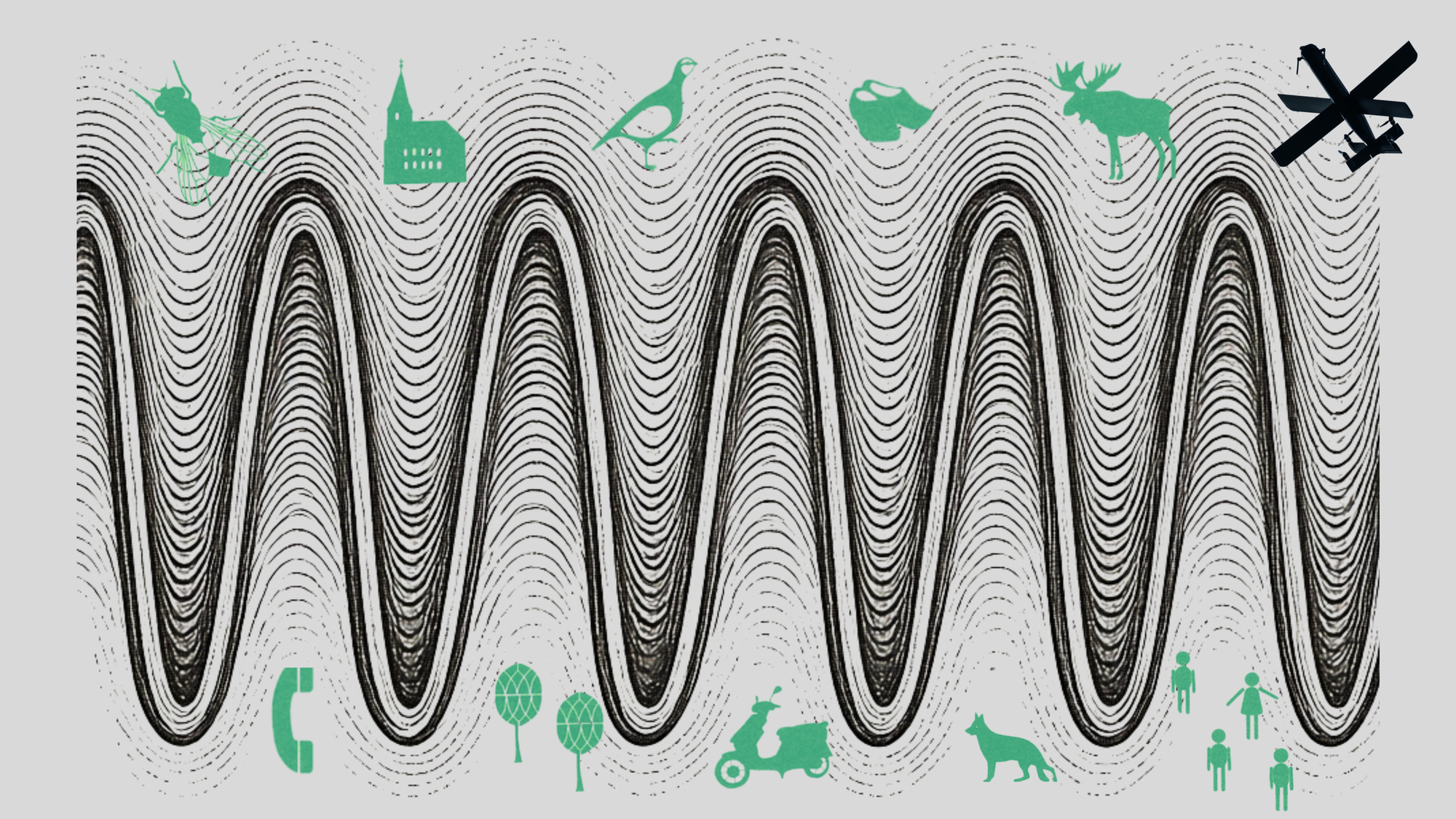
The corporate drive to manage user attention through frictionless audio extends far beyond consumer convenience, serving as an operational laboratory for a broader dual-use economy Under the framework of Civil-Military Fusion (CMF)–a national strategy that found its origins in Mao Zedong’s founding of the People's Republic of China–the traditional boundaries separating civilian cultural platforms and defense innovation have completely collapsed and become explicitly mappable onto the financial and ideological infrastructure of platform capitalism itself. In June 2025, Spotify founder and CEO Daniel Ek utilized his personal venture capital firm, Prima Materia, to lead a massive €600 million investment round into Helsing, a European military technology company specializing in artificial intelligence systems. Ek, who also serves as Helsing’s chairman, has openly championed this integration as a form of "deep tech stewardship" and a "sovereign shield" necessary for European defense autonomy. Helsing’s software specializes applying the automated processing techniques of Spotify directly to the military logistics of manned-and-unmanned drone systems like its proprietary HX-2 strike drone. The structural parallel is absolute: a recommendation engine that extracts data from user habits to predict the next song on a playlist relies on the exact same predictive analytics used by defense corporations to identify and conduct predictive targeting on the battlefield and in tandem with automated surveillance.
This reality has provoked intense ethical resistance and boycott movements from artists and creative unions. Formations like the United Musicians and Allied Workers have condemned the platform for paying creators fractions of a penny while siphoning streaming-generated wealth into lethal technologies. Ek himself noted in a 2024 post on social media platform, X, that “the cost of creating content is close to zero.” Ek even audaciously asked, "what are we creating now that will still be valued and discussed hundreds or thousands of years from today? High-profile bands, including Deerhoof and Massive Attack, have pulled their entire catalogs from the service, explicitly protesting the moral and ethical burden of having their creative output and user behavioral data unintentionally subsidize systems of warfare and autonomous violence. Ultimately, this planetary computational infrastructure forces a return to Schafer’s original, foundational question of how do systems organize human perception through sound? Acoustic environments are no longer shaped merely by the localized forces of industrialization or urbanization, but by intercontinental infrastructures linking entertainment, logistics, surveillance, and technological sovereign within this dual-use paradigm, the human ear must stretch itself beyond consumer leisure and trainable datasets.
The contemporary world soundscape has become an automated and predictive infrastructure that subverts Schafer’s original mandate in The Soundscape, proving that “the only realistic way to approach the noise pollution problem was to study the total soundscape as a prelude to comprehensive acoustic design.” Where Schafer envisioned design as a tool for ecophonal harmony, platform capitalism and military-industrial-entertainment computation have instead weaponized acoustic architecture to automate cognitive enclosure and automated warfare. Schafer’s World Soundscape Project ultimately spanned from the mid-20th Century where developing and decaying soundscapes were documented with analog recording equipment into the new millennium when the research was archived onto an academic web database as a recording library and digitized print catalogue. As AI continues to optimize away the gaps of human delay, the global latency optimization of our sonic environment becomes an invisible, inescapable auditory scene engineered to manage the cognitive conditions of the listener.

Canadian composer and educator R. Murray Schafer’s World Soundscape Project proposed that modern societies produce distinctive acoustic environments composed of and within a signal-to-noise ratio. These auditory environments organize a psycho-spatial social relation that emits a subtle ecological emotion, memory, attention, and collective behaviour. His concept of schizophonia—the separation of sound from source through electroacoustic reproduction—identified recording technology as a decisive transformation of modern perception in which detached and disembodied sonic figures refer to an environmental origin. Sound thereafter could circulate independently from its emotive creators as atmospheric commodities. Under the contemporary conditions of streaming media and machine learning, schizophonia articulates the dominant cultural logic of platform capitalism. In this way, algorithmic suggestion mobilizes music beyond a situated ritual performance into metadata waveforms circulating through the generative behavioural analytics of recommendation systems trained on archives of recorded culture. Genres collapse into searchable vectors and listening environments are personalized through adaptive playlists and AI-assisted biometric feedback systems that anticipate user mood and attention patterns before conscious decision-making occurs. The auditory scene and search index has become computationally managed in the desired economy of user and programmer relations.
What distinguishes the present moment of generative AI derivatives from previous eras of automation and downsizing in the music recording industry is the degree to which computational systems optimize the temporal conditions of listening itself. In the streaming economy, latency optimization and predictive search are infrastructural techniques for governing perceptual delay between user input and playback. Zero latency is at once an engineering achievement as well as an ideological operation designed to eliminate friction from musical consumption. Playback occurs almost instantaneously, producing the sensation that listening environments emerge naturally rather than through commercial orchestration. In the book Mood Machine: The Rise of Spotify and the Costs of the Perfect Playlist journalist Liz Pelly critiques Spotify’s strategy to facilitate less active listening through the continuous modulation of streamed–formerly canned–audio as affective frictionless states of cognition. She describes that founder Daniel Ek’s singular goal was to elevate the cloud-sourcing of music files from piracy into platform economics, ostensibly “freeing” up music’s overall availability to the general public, i.e., the market. “The engineering team even gave themselves a specific metric,” Pelly writes. “Any song should begin within two hundred milliseconds of pressing the button.” The feeling of instantaneous playback via latency optimization restructures listening temporality with unhesitating autoplay algorithms that fill perceptual gaps before silence can emerge. Listeners are transferred from one track to another through seamless transitions, and the predictive auditory scene becomes continuous and atmospheric, untethered from decision-making and active discovery.
At the same time, predictive search reorganizes musical culture around computational legibility where search systems amplify content that behaves predictably. Metadata architectures enforce an invisible hand that guides tracks that are tagged efficiently into recommendation conveyor belts because platforms increasingly reward what Pelly among other critics of Spotify have termed “Spotifycore.” Even the app’s name itself surfaced as the result of latency and disordered audio-processing, when Ek misheard co-founder Martin Lorentzon’s shouts of potential names from a separate room––later the name became a portmanteau of the words "spot" and "identify." Spotify's mood-based and playlist-centric structure–in conjunction with noise-cancelling listening technology and Apple’s little white earbuds–incentivizes a compressed, homogenized “aural wallpaper” that prioritizes background utility over artist identity. Pelly focuses on "streambait" and fake artists that exploit the 30-second stream rule deterministically steered by Spotify’s “black box.” In the 2019 book Spotify Teardown: Inside the Black Box of Streaming Music, Swedish social science researchers Maria Eriksson, Anna Johansson, Rasmus Fleischer, Pelle Snickars and Patrick Vonderau conducted a five day “back-end investigation” with a custom-built interface in which a small fleet of bots were deployed to collect and analyze data from Spotify’s recommendations feature.
The hypothetical framework of the study was to perform an algorithmic audit in order to gather quantifiable statistics on the quality of methods that decides what songs or artists Spotify recommends to listeners of different genders. The initial result of the study yielded no answers, but did show that there was simply too much data for their interface to process: a bold aspect of Spotify’s mystique and selling point. The massive glut of data collected from Spotify’s “black box” seemed impossible to digest and only consumable in small doses. At the core of Spotify’s recommendation feature is the music analysis firm, The Echo Nest, which the streaming platform acquired for €49.7M in 2014. Founded in 2005 at the MIT Media Lab as a dissertation by Tristan Jehan and Brian Whitman (brother of electronic musician, Keith Fullerton Whitman), The Echo Nest operates as a centralizing model of data intelligence that Spotify uses to provide users a seemingly personalized listening experience. Now, under the power of automated suggestion our listening has shifted overtime from an active engagement with music to a passive habit.
Spotify’s “black box” conceals much of its internal logic beneath interfaces organized around personalization and convenience where the reduction of latency begins to function ideologically. Metahaven’s conjectures in the essay “Latent Spacecraft: Brains, GANs, Finnegans” deepen this condition by reframing latency as a defining temporal structure of planetary computation itself in which computational systems can never fully eliminate delay. “Latent spaces” are described as embedded features, spatial vectors that posit an interstitial zone between material and abstract conceptions of the world. “Latent spaces can be laid out as an architectural map, which in turn makes it possible to physically explore abstract concepts that emerge in both human and nonhuman intelligence.” According to Spotify’s 2023 Culture Next trend report: “81% of Gen Z users agree that a singular definable monoculture that most people consume in tandem–like the 6 o’clock news or a morning radio show–does not exist today.” Spotify further reported that “Gen Zs have used our AI-powered DJ to stream over 1.5 billion minutes of music and recommendations globally.” As of 2026, the AI DJ has reached roughly 35% adoption among users.
The intersection between consumer technology platforms and defence innovation is increasingly described as the “dual-use economy,” especially through the framework of Civil-Military Fusion (CMF). In this model, the traditional boundary separating civilian and military technology becomes blurred, allowing the same artificial intelligence systems, data infrastructures, and algorithmic intellectual property to serve both commercial and defense purposes. A recommendation engine that predicts a user’s next favourite song on Spotify, for example, relies on many of the same machine-learning principles that can be adapted by defense firms such as Helsing to identify battlefield threats or assist military decision-making.
At the centre of this transformation is the concept of dual-use technology: innovations designed for civilian markets that also possess strategic military applications. Rather than existing as separate industries, entertainment platforms, AI startups, and defence contractors increasingly operate within a shared technological ecosystem. Data analysis, predictive algorithms, cloud computing, and autonomous systems can move fluidly between consumer convenience and national security. This convergence has become especially important in regions such as Europe and Canada, where policymakers and entrepreneurs promote CMF as a way to strengthen domestic innovation while reducing dependence on larger American or Chinese technology corporations.
Another major concept driving this shift is technological sovereignty. Advocates argue that countries and regions must retain ownership over critical AI infrastructure and intellectual property if they hope to remain politically and economically independent in the future. This idea strongly influences European investment strategies surrounding AI and defence technology. Supporters claim that funding domestic firms capable of building advanced autonomous systems is necessary not only for economic competitiveness, but also for democratic resilience and strategic security.
At the same time, critics warn that this convergence risks militarizing the creative economy itself. Musicians and activist groups, including members of Massive Attack, have argued that profits generated through streaming platforms indirectly support the development of military technologies. From this perspective, artists and audiences may unintentionally subsidize systems connected to surveillance, autonomous weapons, or warfare. Opponents describe this as the erosion of ethical boundaries between culture and conflict.
Defenders of the model, however, frame it differently. They argue that reinvesting profits from successful civilian technologies into defence innovation represents responsible “deep tech stewardship.” In their view, societies that benefit from advanced digital economies must also invest in protecting themselves from geopolitical instability and technological dependency. As AI continues to evolve, the debate over whether these systems represent “blood money” or a “sovereign shield” will likely become one of the defining ethical and economic questions of the modern technological era.
Schafer’s acoustic ecology becomes newly important precisely because his understanding of sound allows infrastructures to be understood environmentally rather than merely technologically. Sound is experienced materially and spatially before it is abstractly processed as information. Schafer’s critique of postwar industrialized and suburbanized soundscapes rejected forms of perceptual narrowing that reduced listening to managed signals optimized for efficiency and control. Today, however, those same principles operate through planetary computational infrastructures increasingly organized around what can be called a dual-use economy. Civilian entertainment platforms and military AI systems share overlapping computational architectures. Recommendation engines, predictive analytics, distributed cloud infrastructures, and machine-learning systems migrate fluidly between streaming services and defence technologies. The same signal-processing systems that predict a listener’s next song can also be adapted toward autonomous surveillance, predictive targeting, and battlefield coordination.
Under conditions of CMF, culture and defence no longer occupy separate domains. They become different expressions of the same computational logic organized around anticipation, synchronization, optimization, and predictive control. This convergence reframes the political stakes of Schafer’s world soundscape. Acoustic environments are no longer shaped only by industrialization or urbanization but by intercontinental infrastructures linking entertainment, logistics, surveillance, and technological sovereignty.
Within this dual-use economy, platforms increasingly function as laboratories for behavioural prediction where attention, mood, habit, and affect become trainable datasets. Recommendation systems become infrastructural prototypes for broader predictive governance systems. The same AI architectures governing playlist continuity and mood optimization can also govern military logistics, autonomous systems, and distributed intelligence infrastructures.
This convergence has produced growing criticism surrounding the militarization of the creative economy itself. Critics argue that profits extracted from musical culture increasingly subsidize AI systems linked to surveillance and autonomous defence technologies. Others defend these investments as forms of technological sovereignty necessary to prevent dependence on larger geopolitical AI powers. The boundary between cultural infrastructure and strategic infrastructure becomes increasingly unstable.
Noise was a deliberate military stratagem
“the only realistic way to approach the noise pollution problem was to study the total soundscape as a prelude to comprehensive acoustic design.”
- R. Murray Schafer
Schafer’s concept of auditory scene analysis becomes newly urgent under these conditions because computational systems increasingly attempt to automate perceptual organization itself. Platforms distinguish foreground from background, isolate vocal stems, classify mood states, identify genre markers, and predict listening habits through machine-learning systems trained on vast archives of recorded music. Sound becomes data optimized for computational legibility.
This transformation intensifies schizophonia to unprecedented levels. Music no longer requires stable relationships to performance, place, or even human authorship. AI-generated songs circulate alongside human recordings within identical recommendation systems. Voices become synthetic avatars detached from bodies. Everyday listening increasingly occurs through environments where sound is generated, classified, distributed, and personalized automatically.
Schafer argued that modern industrial societies developed forms of “sound phobia” in which noise, reverberation, and acoustic unpredictability were treated as threats requiring elimination through engineering and control. Contemporary digital production intensifies this tendency through quantization, adaptive mastering, predictive recommendation systems, and latency optimization designed to produce uninterrupted auditory continuity. Frictionless audio becomes an infrastructural ideal.
Against this horizon, the recursive approach of studio-performance logic developed by Miles Davis during the making of On the Corner and Get Up With It increasingly treated recording studios as compositional instruments capable of restructuring spatial perception through editing, overdubbing, and post-production montage. “While recovering from my car accident, I studied a lot more of [Karlheinz] Stockhausen’s concepts of music,” Davis reflected in Miles: The Autobiography. “I got further and further into the idea of performance as a process.” What Davis recognized in Stockhausen was not simply abstraction but a new conception of recording as an environmental organization where sound could function architecturally. “I had always written in a circular way and through Stockhausen I could see that I didn’t want to ever play again from eight bars to eight bars, because I never end songs; they just keep going on.” The spatial reorientation of rhythm and harmony through editing generated a novel shift when reconsidered through Schafer’s acoustic ecology because Davis’s electric period effectively transformed the studio into a site for constructing artificial auditory scenes from very LIVE and real moments. Under conditions of planetary computation, the contemporary world soundscape is no longer merely industrial or urban. It is predictive, algorithmic, synthetic, and increasingly governed through infrastructures where culture, logistics, entertainment, and military sovereignty converge. The question is no longer simply how sound is recorded or distributed, but how computational systems increasingly organize perception itself through the management of time, attention, and environmental experience. Davis described this shift directly: “The sound’s gone up, that’s all.”
Read more
Art Under Capital and Beyond It

Bespoke Devotional