Pipe Dreams: 10 artists reimagining the pipe organ in “Canada”
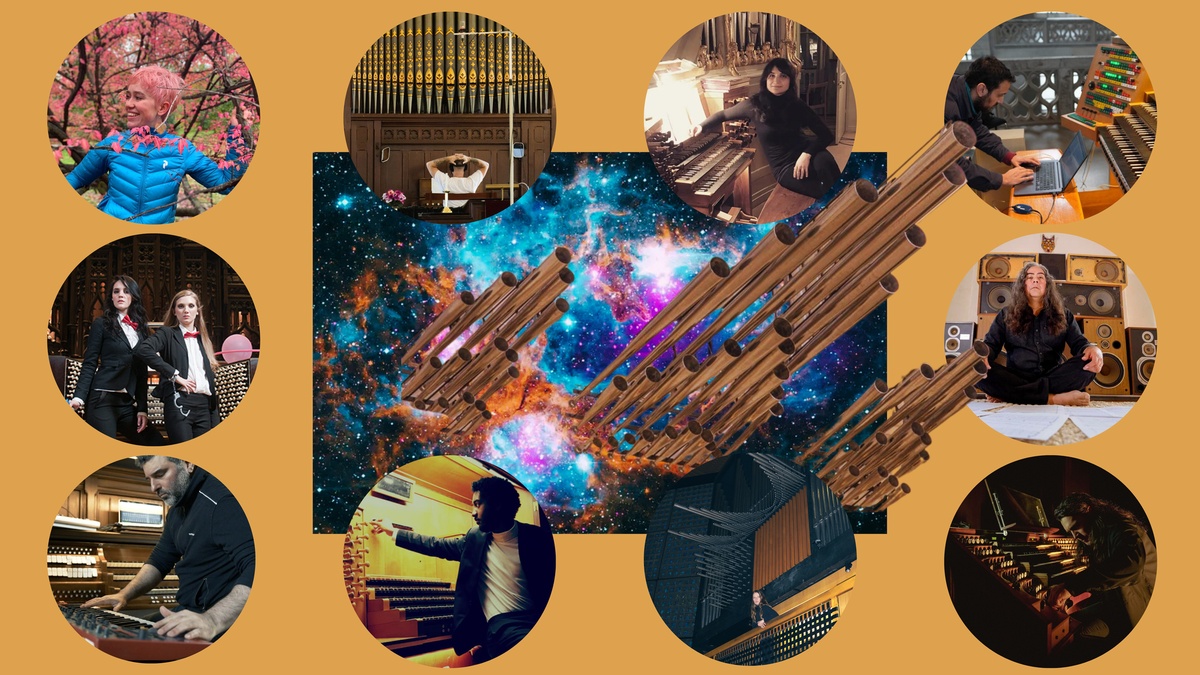
For centuries, pipe organs have been treated as sacred technology that supposedly mediates the very voice of God. As a result, the churches that house the instruments have long maintained strict control over who can access and perform on them. But the contradictions of neoliberal capitalism have complicated that relationship, prompting worship houses to choose between private capital investment or (often publicly funded) community rentals and arts programming to offset house costs. In that tension, a new generation of artists hailing from the secular worlds of experimental music, jazz, noise, punk, contemporary classical, and electronic composition are breathing new life into the organ, reimagining it as everything from a proto-synthesizer to a networked computer, and a radical vehicle for communal imagining.
Sarah Davachi
Los Angeles-based Alberta expat Sarah Davachi relates the organ and their unique structural complexities to synthesizers, and she should know, having intimately familiarized herself with both as a former interpreter and content developer of the National Music Centre’s collection of acoustic and electronic keyboard instruments in Calgary. Last year, she told New Feeling her interest in the instruments was piqued at an early age when piano lessons led her to explore more keyboard instruments. Recognizing how they allowed musicians to hone in on things like the timbral eccentricities produced when a given instrument plays a specific chord, she uses findings from her deep listening to inform the broader details of her drones. Her upcoming triple album The Will of Tongues promises to deliver two hours of compositions for historical pipe organs, a suite of three choral pieces, a collection of “interludes” for various microtonal ensembles, and a longform chamber piece for string trio, organ, and tape.
John Kameel Farah
Living between Toronto and Berlin, John Kameel Farah’s work is a practice of bridging worlds. Stationing himself at the helm of intricate cockpits assembling grand pianos, electronic keyboards, or towering church organs with laptops and an arsenal of analog synthesizers, the Palestinian-Canadian keyboardist and composer pours himself into fugal works from Bach, Palestinian folk songs, and original passacaglias. Weaving each of those sources together in a hybrid form he has variously described as “Arabic futurism,” “Middle-Eastern futurism,” or “baroque-Middle-Eastern-cyberpunk,” his music is an attempt to reveal collective paths forward through ancient interdependent histories of expression.
Kara-Lis Coverdale
A seasoned church organist, Kara-Lis Coverdale spent her teens working at churches all over southern Ontario before journeying down the path of experimental music and modern composition. Indebted to popular forms as much as the angelic, her solo music is not mutually exclusive from the sacred music she grew up playing, but something more inclusive. Coverdale’s experience with the pipe organ often informs her approach to more studio-friendly electric organs, pianos, and modular synthesizers, but she continues to perform drone concerts on church organs. In one radical undertaking, a 2015 collaboration with US producer LXV blended pipe organs, pianos, and synth drones with sampled sounds of war chants, punching bags, and bodies impacting wrestling mats.
Michael Cloud Duguay
For his new album, Peterborough, Ontario-based droner Michael Cloud Duguay journeyed more than 1000 miles across Newfoundland and dug a church organ out of a pile of rubble. Arriving July 10 via Duguay’s Watch That Ends the Night label, a press release explains Kingdom Come, Kingdom Go features seven different organs recorded in just as many historic churches and remote regions throughout the province. Recorded over the course of a week with a solar-powered recording studio, the album is “not a standard issue record of organ music,” but “an abstract musical documentary” about them. In some places, dialogue from informal interviews also shares the stereo field directly with the instruments they’re concerned with.
Kim Farris-Manning
Montreal-based composer Kim Farris-Manning’s organ practice blends performance, experimentation, and spatial thinking. While pursuing her undergraduate degree at the University of Victoria, she served as organ scholar at St. John the Divine, where her evolving work MAP; gest debuted. Reflecting on the tension between the earth’s spherical form and the flatness of paper maps, her composition translates spatial distortions through the interpretation of the performer. Its score mimics the form of a conical projection and functions as a navigational chart, requiring the performer to engage and interact with the changes they encounter each navigation. She expands the instrument’s acoustic and expressive possibilities by introducing a microphone and daisy-chained guitar pedals into the organ’s swell-box.
Raven Chacon
Although not an organist himself, Raven Chacon has composed significant works incorporating the pipe organ, most notably 2021’s Voiceless Mass. Originally commissioned for the Nichols & Simpson organ at the Cathedral of St. John the Evangelist in Milwaukee, Wisconsin, the Pulitzer Prize-winning piece is a mass by name, but contains no human voices. Addressing the legacy of the Catholic Church and its role in the attempted genocide of Indigenous peoples, the piece seizes on the pipe organ’s structural relationship to the space it inhabits — organs and their venues are one and the same. Through sustained tones and spatial acoustics, the work reflects on silence, absence, and the futility of giving voice to the voiceless.
George Rahi
Routinely gesturing to the ways pipe organ interfaces pre-empted early computer aesthetics, Vancouver composer George Rahi has developed a robust practice around the technological potential of the instrument, suggesting we might look to it as a model for new revolutions. In an increasingly automated culture, he has adapted the instrument accordingly through his Music for the Augmented Pipe Organ performances and his participation in the Global Hyperorgan concert in 2023. He extends the pipe organ towards digital and networked technology, developing digital interfaces that allow users real-time manipulation of the instrument’s pipes and stops in ways no human body could ever achieve alone.
Organized Crime
Traditionally sacred instruments, most churches are tenaciously protective of their pipe organs. Sarah Svendsen and Rachel Mahon, seasoned organ scholars and educators active at churches in Toronto and the United Kingdom, have used the access they’ve gained to the instruments over the years to bring pipe organs to entirely new audiences. Performing together as musical comedy duo Organized Crime, they’ve built a routine turning the organ into an alter for hilarity — using them to conjure epic renditions of pop culture themes, playing the consoles upside-down in five-inch stilettos, or pairing the canonical sounds of the William Tell overture with a chorus of popped balloons.
Rashaan Rori Allwood
At home in live performance with contemporary electronic ensembles and jazz ensembles alike, Rashaan Rori Allwood is the director of music at St. Ansgar Lutheran Church in Toronto, where he regularly premieres new works. Pushing the boundaries of contemporary music, he has performed with the Orchestre symphonique de Montreal and Houston Civic Symphony. His 2019 opera Bright Bottles is a three-tableaux opera for chamber string ensemble, organ, and a percussion section of suspended plastic bottles.
Stefan Maier
Highlighting material instability and unruliness, as an artist and composer, Stefan Maier’s work frequently explores how sonic matter flows through buildings, sound systems software, and bodies to uncover minor histories, sonic fictions, and alternate modes of listening. As part of an ongoing project in “speculative medievalism” — a growing body of “forged compositions” exploring occult practices in the late Middle-Ages — he premiered Tractatus de Umbra Manus (1447): The Fifth Hammer at Vancouver’s Pacific Spirit United Church in 2022. Examining the history of mystical spatial composition at the turn of the renaissance, the piece gleans techniques spanning the Venetian polychoral tradition to the implied divine spatialities of early Renaissance composer Guillaume Du Fay, throwing in a loud speaker for good measure.
Read more
Art Under Capital and Beyond It
Bespoke Devotional