Angine de Poitrine could only hail from la belle province
Explaining the Quebec context for everyone's new favourite band
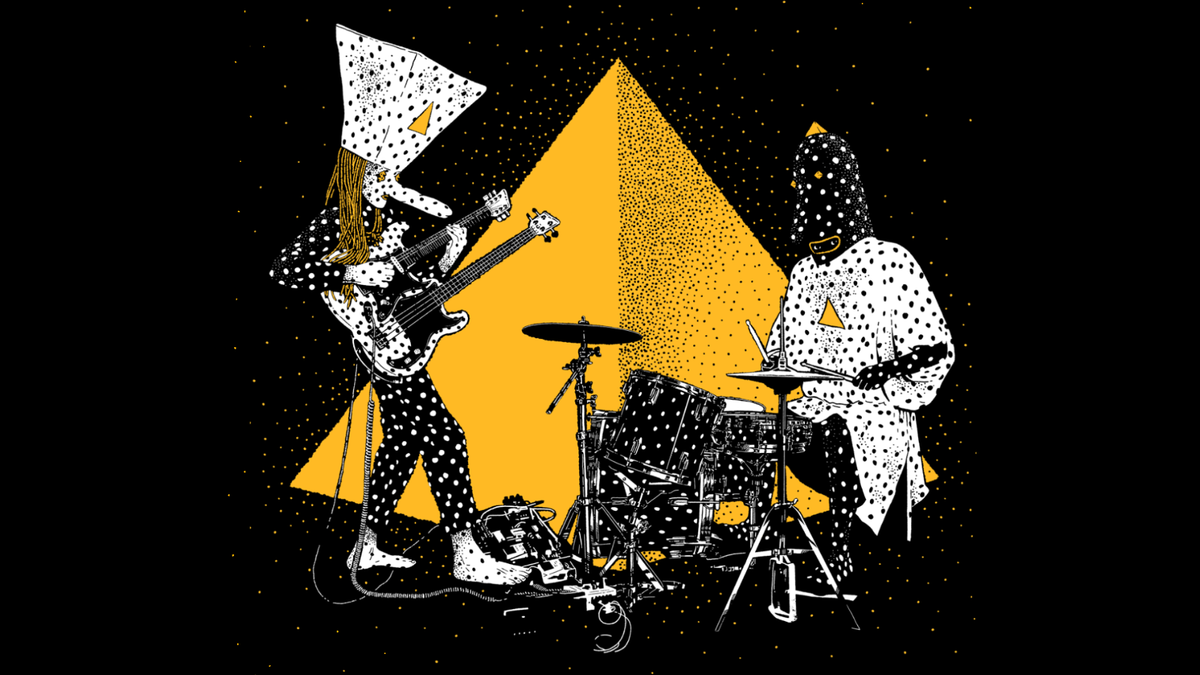
Like everyone else, I watched the KEXP video on Youtube and was immediately blown away by Angine de Poitrine. Over the past month, as the views on that video grew, so too did the number of reaction videos, mostly musician dudes losing their collective minds and just staring at the polka-dotted extraterrestrial duo as they played their microtonal tunes.1
Reviews and articles about the band link them to a range of math rock and prog rock outfits. Pitchfork mentioned Primus, Zappa, and King Crimson, The New York TImes extended their comparisons to include Captain Beefheart, Mahavishnu Orchestra, Tinariwen, Battles, and King Gizzard & the Lizard Wizard. Closer to home, Exclaim! leaned into similar comparisons while giving the band’s latest album a 10/10. But generally, folks in the Great White North are pretty charmed overall, in both official languages. I’m particularly thrilled that the costumed act from Quebec — Saguenay, to be specific — playing “Dada Pythagorean-Cubist mantra-rock” (their words, not mine) is a viral sensation that appears to be transforming into a bonafide sensation.
I love that it represents an argument against AI slop music, but more than anything, I love just how much who and what they are stems from the environment in which the band was born and grew. On our wee Youtube channel, my friend Ryan and I talked about how Heated Rivalry could really have only come from the province we call home, and fellow Montreal journalist Toula Drimonis then wrote about how the show is “so Quebec-coded”.
I would argue that Angine de Poitrine is also very, very much Quebec-coded. Sure, Khn and Klek de Poitrine do not sing in French; they prefer a robotic gibberish language of their own making that they (some say thankfully) don’t use that much. My theory, however, is that Angine de Poitrine represents a strain or element of Quebecois music that has been around in various forms for decades.
Bring on the Cirque Rock
I’ve talked about this with friends, but perhaps now is the time for me to share my theory with the world. I’m interested in thinking through this idea in public and happy to receive feedback. I think that Angine de Poitrine is an example of what I might refer to as cirque rock (“circus rock”).
As many people are well aware, Quebec is the home of Cirque du Soleil. Since the early 1980s, Cirque has been reconceiving circus in wildly different ways. The unique theatricality and complex, technically virtuosic performance resists the expectations of any one who has an idea of what a circus can and should be. Avant-garde acrobatics and no animals changed the way audience sees circus as a concept. To me, there is a parallel history of Quebec music that reflects these elements of envelope-pushing theatricality and technical complexity.
Roots in Musique Actuelle
If you go back four decades, to around the same time that Cirque was in its infancy as street performance, you will find the establishment of the Festival International de Musique Actuelle in Victoriaville, Quebec.
The festival was and remains a space for experimental music, free jazz, avant-garde stuff. Lineup alumni include international acts like John Zorn, The Ex, Sonic Youth, Jim O'Rourke, and Godspeed You Black Emperor. The people who developed the festival had a collective that then became the experimental record label Ambiances Magnétiques, founded by guitarist René Lussier, wind instrumentalist Jean Derome, guitarist André Duchesne and clarinetist Robert Marcel Lepage. Joane Hétu, Diane Labrosse, Danielle P. Roger, Michel F. Côté, and Martin Tétreault were also involved and very much worth your time to listen to.2
This whole situation was kind of unique and avant-garde, ahead of its time, etc. Also, keep in mind that Angine de Poitrine is very much from not Montreal, much like how Victoriaville is a ways away from the urban centres of Quebec. Khn and Klek are from space yes, but that space is Chicoutimi in Saguenay, which is a five-hour drive from Montreal. I should also mention the Centre d’expérimentation musicale (CEM) is in Saguenay — and has been there since 1980.3 So playing around with music is clearly not a new thing in what folks in Quebec call “les regions.”
Toss in some prog
Another act that came from Saguenay is Voivod. Though very much a metal band, they possess a progressive rock bent — technical, prog metal, if you will. Angine de Poitrine shares this link to Quebec’s prog rock. Voivod started in 1982 and has been active for decades (they are touring in 2026). Their bassist, keeping with the strands of theatrical weirdness, and the avant-garde proclivities, left the band, moved out to Vancouver, and started a dance troupe called the Holy Body Tattoo.4 All of the cirque rock elements are there (and the alien stuff as well — see below).
21st Century Quebec Weirdness
In Montreal this year, celebrating 25 years, is Casa del Popolo, which came out of another venue called Artishow, which was not exactly a legal venue — they famously sold booze in teacups. Co-founded by Godspeed You! Black Emperor bassist Mauro Pezzente, Casa (and its related venues in the city) has always hosted what might be called “weird bands.” The freewheeling atmosphere of the 1980s and 1990s started to come to the fore as Montreal became an indie rock hotspot in the early 2000s with bands like Wolf Parade and Arcade Fire and Stars and the Dears and and and. But this was more Anglophone.
On the French side of things, you had bands like Les Georges Leningrad who were around from about 1999 to 2007. They, much like Angine de Poitrine, wore masks and had character names. Their performances were kind of nuts. Their bizarre 2006 album Sangue Puro (on Dare to Care, which became Bravo musique after singer Cœur de Pirate bought it) is bananas, but worth a listen. They would perform alongside bands like Duchess Says (who released music on the wonderfully odd late 1990s/2000s record label Alien8). There are also a bunch of other bands from around that period of time who could be seen as cirque precursors to Angine de Potrine.
Example: Gros Mené. They started in 1998. In 2013, they release an album called Agnes Dei, which won the Félix for album of the year.5
And then, just over 10 years ago, you get Fantôme and zouz and Patche — three bands adjunct in sound and concept to Angine de Poitrine: experimentation with elements of theatricality that challenge the listener.
There’s also the mighty Fet.nat, a band whose 2019 album Le Mal was shortlisted for Canada’s Polaris Prize.6 I hope you are starting to believe me when I say that there’s clearly something in the water.
Even more pop and folky Franco music leans into the theatrical. Check out the circus-y Klô Pelgag: costumes are very much a part of her performance style. Hubert Lenoir presents a more loungy pop sensibility, but again, incredibly theatrical. His most recent album, PICTURA DE IPSE : Musique directe, was also a bit of an experimental thing in terms of using voice notes and approaches in keeping with the concept of “musique directe,” an interpretation of “cinema directe.”7 Journal d’un loup-garou (“diary of a werewolf” from musical darling of 2025 Lou-Adriane Cassidy) also presents a theatrical, mysterious feel.
All this is to say that I think that in the same way that Quebec gave the world Cirque du Soleil, this circus mentality pushes the artistry, pushes the theatricality, pushes the complexity, the technicality, the avant-gardism. This is where Angine de Poitrine comes from. I also like that there’s a resistance to norms as well.
In a February interview, Angine de Poitrine8 speak in their “real” voices about how they as individuals are uncomfortable with the idea of “personal branding.” This is part of why they created these characters the way they have (think of the dollar signs on the eyes) to be able to present the music, the product that they’re selling. Rather than having to adapt themselves to fit some image, they’re creating this universe around Angine de Poitrine. Like Casa del Popolo, it is part of that consistent attempt to challenge notions of commodification and really lean into the weird as much as anything else, leaning into the artistry. And Quebec is a place where this happens.
Note #1: Before the release of their most recent album, simply called Vol. II, we tackled the origins of Angine de Poitrine and received such wonderful feedback and suggestions that I thought I would expand on some of the ideas here. You can also listen to a whole playlist featuring the music I’ve discussed — I am quite thrilled that Angine de Poitrine’s own Quebec music playlist (released significantly after mine) contains a fair amount of what I have mentioned!
Endnotes
1. As a tiny respite from all of the horror going on, Angine de Poitrine has been a balm.
2. I had a radio show in the 1990s and I used to play a bunch of musique actuelle. I had a friend call in once and ask if I was playing the sounds of household appliances.
3. Thank you to a commenter on our YouTube that helpfully brought this up!
4. Who have performed with Godspeed…the connections keep coming!
5. These are given by the Association du disque, de l’industrie du spectacle québécois on an annual basis to artists working in the music industry in Quebec.
6. Full disclosure: I’m the jury foreperson for the Polaris, and I think it is one of the most unique prizes out there in that it’s willing to lean into the weird and wonderful of Canadian music so often.
7. A style of documentary filmmaking in Quebec back in the 1950s and 1960s.
8. One that I can’t find online any more — it was on the Aucard de Tours podcast (from the festival by the same name). Interestingly, a whole lot of the stuff that directly connects the band to their actual identities has been stripped from the internet. I’m fine with this. There’s no need to reveal what they don’t wish to reveal.
This article has been edited and republished from Erin MacLeod’s Substack, Touch of All Right.
Read more

Art Under Capital and Beyond It
Bespoke Devotional